5S Kaizen Event, JIT and Kanban
Kaizen Event and Kaizen Blitz
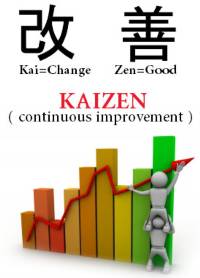
The step wise continuous improvement process as described by Masaaki Imai in his book "Kaizen" shows how many small improvements contribute tremendeously to improving overall performance. This is contrary to the "big leap" approach that is sometimes preferred. In order to facilitate or speed up the continuous improvement process it can be helpful to have a so-called Kaizen Event or Kaizen Blitz. The Kaizen Meaning or definition: The word "Kai" means change, the word "Zen" means good, therefore in English it is usually translated as continuous improvement.
A Kaizen Event is a 3-5 day event in order to have improvement potential indentified AND implemented. A Kaizen Event is usually organized with the following rules in mind:
1. Create a multi disciplinary team consisting of operators, managers and owners of the process2. Announce the Kaizen Event including reasons why and what the intention is to achieve.
3. Map the existing process, for example VSM: Value Stream Mapping or Value Stream Analysis. Identify and implement improvements on the existing process
5. Measure results and identify areas for replicationThe method solicits buy-in from all parties related to the process
A Kaizen Event is an extremely powerful and efficient way to quickly improve a process and to eliminate waste. The intent of a Kaizen Event is to hold small events attended by the owners and operators of a process to make improvements to that process which are within the scope of the process participants.
Usually the "low hanging fruit" is identified and the improvements most of the time are low cost and no cost improvements, for example 5S Workplace Organization
Kanban and JIT: Just in Time
"JIT" means making "only what is needed, when it is needed and in the amount it is needed". For example, to efficiently produce a large number of automobiles, which can consist of around 30,000 parts, it is necessary to create a detailed production plan that includes parts procurement. Supplying "what is needed, when it is needed, and in the amount needed" according to this production plan can eliminate the 7 wastes, inconsistencies, and unreasonable requirements, resulting in improved productivity.
Kanban System
 Kanban System
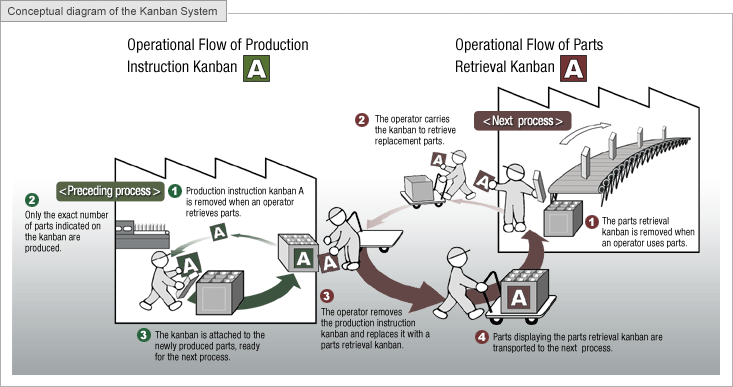
In the TPS (Toyota Production System), a unique production control method called the "kanban system" plays an integral role. The kanban system has also been called the "Supermarket method" because the idea behind it was borrowed from supermarkets. These mass merchandizing stores use product control cards upon which product-related information, such as a product's name, code and storage location, are entered. Because Toyota employed kanban signs for use in their production processes, the method came to be called the "kanban system". At Toyota, when a process refers to a preceding process to retrieve parts, it uses a kanban to communicate which parts have been used. Two kinds (the poduction instruction and the parts retrieval kanban) are used for managing parts.
Evolution of the Kanban System through daily continuous improvement
Through continuous improvement, the system has evolved into the "e-kanban" which is managed using IT methodologies and has increased productivity even further.
Why use the supermarket concept in Kanban?
A supermarket stocks the items for customers in the quantity that matches the consumption or sales, and it has all these items available for sale in the right quantity. Taiichi Ohno (a former Toyota vice president), who promoted the idea of JIT applied this concept equating the supermarket and the customer with the preceding process and the next process, respectively. By having the next process (this can also be the internal customer) go to the preceding process (the supermarket) to retrieve the necessary parts when they are needed and in the amount needed, it was possible to improve upon the existing production system. No longer were the preceding processes making excess parts and delivering them to the next process, leading to unnecessary wastes.