TPM Total Productive Maintenance - the TPM pillars explained
TPM is an excellent program to improve ownership and teamwork, including administrative departments.
Total Productive Maintenance is a continuous process improvement program and aims at engaging ALL employees. The Japanese characters mean "Total People Participation!". TPM consists of a foundation and the foundation provides the framework for the pillars. This includes organization, communication, leadership as well as methods and tools. Although the pillars are next to each other, they work in parallel and are connected. Teamwork is the way of working for the entire program. This also explains why Policy Deployment and Policy Alignment are important basic elements and part of the foundation! As well as Operator Driven Safety: Safety First!
What is the TPM structure?
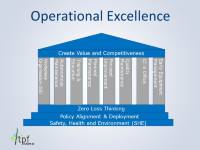
Total Productive Maintenance has a foundation with pillars. These pillars are specific subjects and are connected by the team based approach.
The foundation supports the rest of the building:
- Safety, Health and Environment
- Policy Alignment and Policy Deployment
- Loss Analysis and Overall Equipment Effectiveness: OEE
Behavior and Leadership Style are very important ingredients for TPM to work. It is about teamwork, engagement which also implies delegation of tasks and responsibilities!
The TPM pillars:
- 5S workplace organization and standardization
- Autonomous Maintenance / First Line Maintenance / Operator Driven Reliability
- Training & Education
- Planned Maintenance
- Focused Improvement
- TPM in Office
- Early Equipment Management
- Quality Maintenance
Operator Driven Safety
A safe working environment is a basic condition and "license to operate". When safety is not on "top of mind" for everybody then consider yourself in trouble. Behavior, including example behavior, calling each other to account and ownership contribute significantly to create a safe environment.
Safe working is more than procedures, laws and guidelines. Behavior is an important -if not most important- factor.
Safe working must be an all employee item. Ownership and engagement: everybody every day, from CEO to operator will bring the best result! An Operator Driven Safety program is an excellent way to do this.
Policy Alignment and Policy Deployment
Every organization has goals. How do we ensure that everybody knows what those goals are, what is expected from everyone, how everyone can contribute and how do we enable that individuals can take initiative to contribute to these goals? This communication process is usually referred to as "Policy Alignment" and "Policy Deployment".
Determining specific goals, cascading them into the organization and to work on them step by step are important to achieve sustainable results. It is a 3-5 year vision, which helps to put short term activities into a long term perspective. It helps to choose direction and in some cases: priorities.
Measuring progress and success is usually done with the following KPI's Key Performance Indicators: S, Q, P, C, D, M.
S: Safety
Q: Quality
P: Productivity
C: Cost
D: Delivery Performance
M: Morale or motivation
A vision board can be very helpful to contribute to the policy alignment and policy deployment.
Loss Analysis and OEE: Overall Equipment Effectiveness
A Zero Loss Analysis involves all aspects of the organization: safety, illness rate, late deliveries (customer), quality and environmental losses etcetera. The losses in administrative processes as well as the losses in production are taken into account.
When we realize that in many factories, the valuable operating time expressed in terms of OEE Overall Equipment Effectiveness is less than 50% of the gross available hours per year, it is obvious that our assets are not sweating. Part of this is caused by scheduled downtime, which includes holidays, no production planned due to limited load, spare capacity to cope with volume flexibility etcetera. The other part is caused by the fact that we do not produce fully efficiently. The reasons for this can be categorized into the TPM six big losses. These losses can be influenced during development and production.
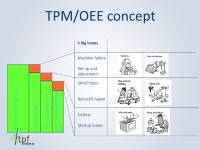
Total Productive Maintenance is THE approach to improve your OEE Overall Equipment Effectiveness in a structural manner.
TPM focusses on improving the efficiency of the Planned Loading Time. The gap (losses) between 100% and actual efficiency can be divided into 3 categories:
- Availability: Breakdowns and changeovers indicate situations where the line is not running while it should be
- Performance: Speed losses and small stops/idling/empty positions indicate the line is running, but is not providing the quantity it should.
- Yield (Quality Rate): when the line is producing products, there are losses due to rejects and start-up quality losses
The Overall Equipment Effectiveness or OEE indicator is like the thermometer for your improvement potential. Total Productive Maintenance helps to improve the OEE by providing a structure to quantify these losses, and by subsequently giving priority to the most important ones. TPM provides concepts and tools to achieve both short and longer term improvements.
5 S workplace organization and standardization
The 5S method is a structured program to implement workplace organization and standardization. 5S improves safety, work efficiency, productivity and ownership. And a well organized workplace motivates people.
The program is called 5S, since all steps start with an "S".
Sort deals with the contents of a workplace, and removes all items that are not needed there.
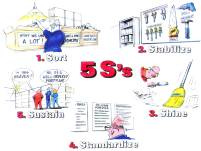
Set in Order refers to "a place for everything, and everything in its place" to enable easy access to needed items.
Shine refers not just to cleaning, but to "being proud" about the way the workplace is organized.
Standardize refers to having standards that everyone has to adhere to. Visual management is an important aspect to facilitate easy understanding of these standards.
Sustain refers to training of all employees and communication to all employees to ensure 5S application.
The 5S management program facilitates an excellent performance:
Safety: a well organized and orderly workplace is a safer workplace. 5S activities remove clutter, visual indicators alarm people for hazardous situations.
Improving production efficiency: 5S supports a smooth production process in various ways. Searching for tools is eliminated, flow principles are applied, and tools storage is done where they are needed most. Location indicators visualize how things have been organized, and non conformities are seen at once.
Quality improvement: Daily activities like inspection help to keep the production process in the right condition. Defects are prevented, because deviations are spotted before they result into defects.
Controlling your workplace: 5S helps to control the workplace by:
Determining what is needed, and where it is needed.
Defining the appropriate location for tools and other materials.
Maintaining these standards.
The 5S online video training program is available in English, French, Spanish, Italian, Dutch and Arabic.
English | Español | Français |
Italiano | Nederlands |
Autonomous Maintenance / First Line Maintenance / Operator Driven Reliability
Autonomous maintenance sometimes referred to as first line maintenance or operator driven reliability has become more popular in the last years. In Total Productive Maintenance as well as in RCM -Reliability Centered Maintenance- this pillar is extremely important in a mechanized production environment and it is a cornerstone in any effective maintenance program.
TPM as well as RCM have in common that they aim at preventing unplanned stops and other unplanned disturbances (for example quality defects). The keyword here: unplanned. The operator plays an important role by doing a number of activities that are:
- relatively easy to learn
- frequently done (minimum once per day)
Advantages:
- unplanned stops and disturbances are prevented
- operator involvement and knowledge level about "their machines" is improved
- less scheduling issues between production and maintenance
- more time for technicians to work on other maintenance tasks
TPM suggests the following daily tasks for operators:
- inspections and cleaning
- lubricating
- minor repairs / adjustments
- trouble shooting
- check of fixtures, bolts and nuts
- replace wear parts
A number of conditions have to be met for implementing this program.
The first line maintenance goals are:
- to organize the work between operators and technicians
- to increase knowledge, skills and operator engagement
- to improve machine reliability (predictability)
- to free up technicians so they have more time to work on revisions, overhauls and new machines
The method's strength is in the way daily activities are organized which also provides a boost for operators and technician in terms of motivation.
Training and Education
Training and Education play a central role. Determining the knowledge and skills required for all roles has to be done, individual development paths need to be established (what would I like to do and what are the requirements for that role?), developing training material (both theory and practice), taking into account different learning styles.
A Gap analysis can help here to determine the gaps and to set priorities in resolving it.
Planned Maintenance
Planned Maintenance are tasks typically done by the technicians. It also includes supporting the autonomous maintenance program (for example training) as well as the following competencies:
Management of:
- Lubricants and lubrication program
- Spare parts
- Predictive maintenance, for example condition based predictive maintenance
- Preventive maintenance
- Maintenance cost
- Knowledge and skills for technicians and operators (autonomous maintenance)
- Breakdown free operation (Zero Failures)
Focused Improvement
Focused Improvement are improvement activities that start from the loss analysis. The loss analysis helps to put different issues into perspective and in setting priorities.
The improvement process in this pillar is also known as DMAIC: Define, Measure, Analyze, Improve, Control.